

Humans Always Get the Last Word
Why death can never erase us
Death, while biologically final, does not have the final say over a human life. The enduring power of our existence lies not in avoiding death, but in what remains after it.
What endures is the legacy we create — the imprint of our relationships, our influence, and the ways we reshape the inner worlds of the people who knew us. That legacy becomes the “last word,” a conscious or unconscious act of defiance against oblivion.
I’ve been thinking about how much of grief is shaped by the story we inherit about what happens after death. Not just what we believe, but what we assume is normal. The default setting. If you grow up in certain parts of the world, one particular version of the afterlife can feel less like a tradition and more like gravity, so culturally embedded it barely registers as a perspective at all.
We don’t notice the default until we step outside it. Grief is universal. The afterlife? That’s where the stories diverge.
In many Christian traditions, it’s easy to assume that “heaven” is simply where grief leads. Reunion. Seeing your loved ones again. Separation, but not forever. For many people, that promise is deeply comforting. Paradise. Resurrection. Love interrupted, not ended. Sometimes described symbolically, sometimes quite literally.
That matters. It holds people.
But it isn’t the only way humans have tried to live with loss.
In Judaism, the afterlife tends to be less central to mourning. Grief leans on ritual, memory, and carrying forward the goodness of the person who died. The question becomes less “Where are they?” and more “How do I honor them now?”
In Islam, the afterlife is vivid and morally structured — judgment, mercy, paradise. Comfort often comes through trust in divine justice and surrender to God’s will.
In Hinduism, death is transition. The soul continues through rebirth, shaped by karma. Nothing disappears; it transforms.
In Buddhism, impermanence is foundational. There is continuation, but no fixed self to preserve. Grief becomes a practice in loving fully while accepting change.
Many Indigenous traditions speak of ancestors rather than absence — the relationship shifts form but doesn’t vanish.
And secular perspectives may not map out heaven at all. Instead, they hold legacy: impact, influence, the ways someone permanently reshaped the inner world of those who loved them.
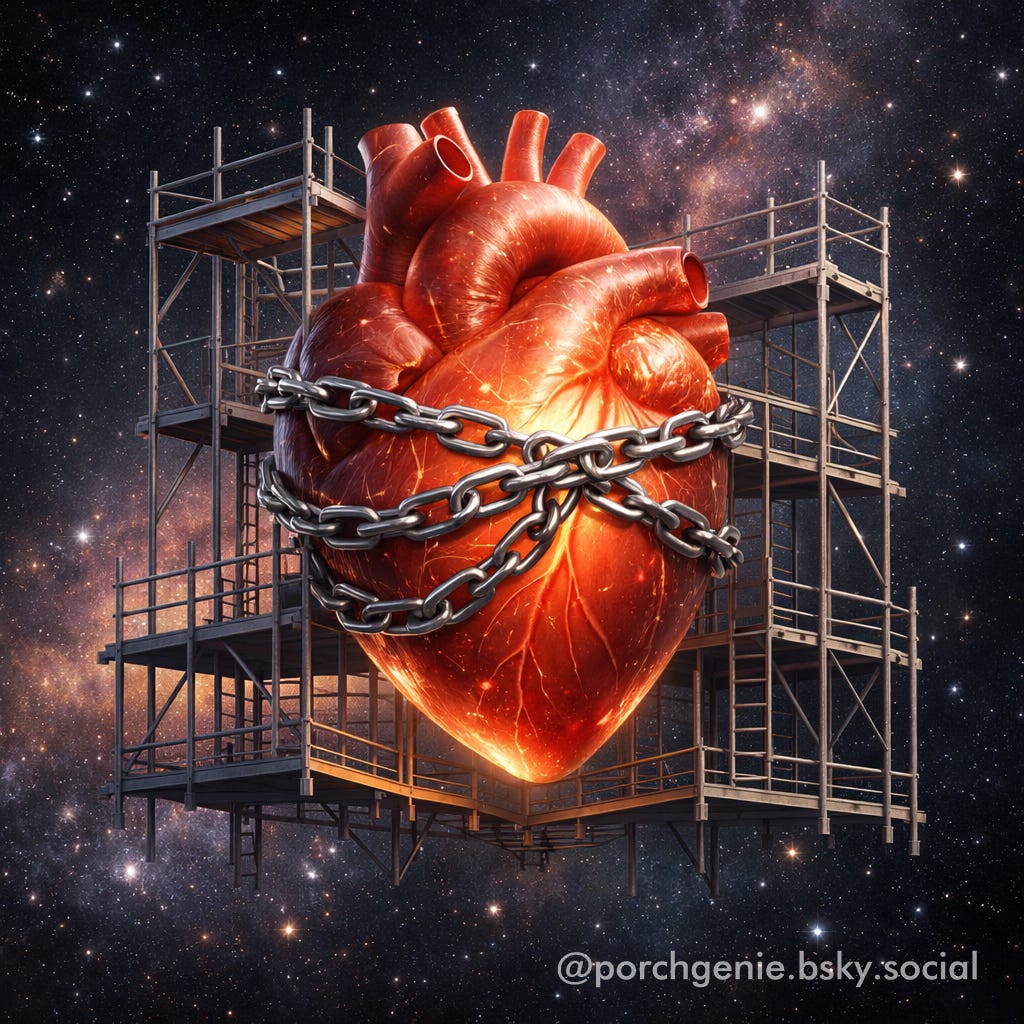
Zoom out and the patterns begin to appear.
• Reunion — We will see them again.
• Continued Presence — They remain with us in some way.
• Transformation — They move through a larger cycle.
• Legacy — They live on through what they changed.
Same infrastructure, different scaffolding.
Humans don’t tolerate relational annihilation well, and attachment isn’t abstract. The people we love shape how we regulate emotion, how we understand ourselves, and how we feel safe in the world. When they die, it isn’t just sadness, it’s destabilization.
So we build cosmologies that protect connection.
Some describe landscapes.
Some describe moral arcs.
Some describe cycles.
Some describe memory.
Literal or symbolic. Detailed or restrained. All of them are trying, in their own way, to make sure love doesn’t collapse into nothing.
Maybe the most revealing thing isn’t which story is correct. It’s how consistently humans refuse to let death have the final word over relationships.
Humans always get the last word.
— Sweeney the Genie
→ Return to the Porch
→ About the Porch Genie
→ Uncork the Bottle