

Lady Godiva Rode Naked Through Town and We Still Haven’t Decided What Women’s Bodies Mean
How an 11th century noblewoman became a permanent cultural argument about shame, power, sexuality, and public morality
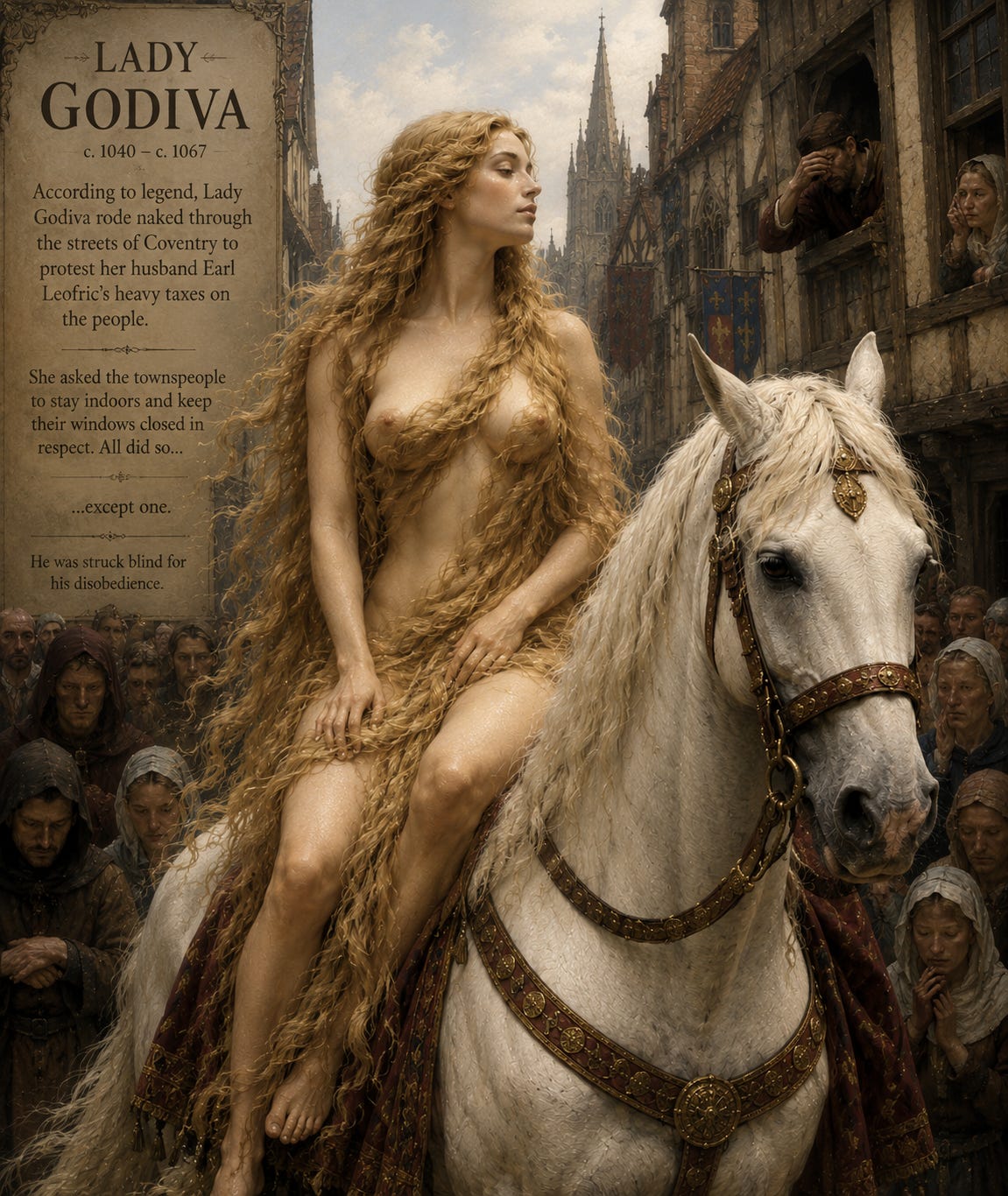
Everyone involved understands the social rules immediately, even across a thousand years of distance. Godiva understands shame. Her husband understands spectacle. The townspeople understand restraint. Peeping Tom understands entitlement. Nobody has to explain why the image still feels culturally charged because the underlying argument never actually disappeared.
The technology changed, but not the psychology behind it. Instead of villagers standing behind shuttered windows, we now have millions of strangers scrolling past each other on glowing screens while algorithms try to sort human expression into categories clean enough for advertisers and moderation systems to tolerate.
The same image can be interpreted as art, pornography, activism, exploitation, empowerment, or obscenity depending almost entirely on context and who controls the framing. Most censorship debates are not really about nudity in the literal sense. They are arguments about ownership, intent, morality, and power disguised as debates about exposure.
What makes the Godiva legend interesting is that the body itself is not really the point. The point is that she was expected to experience humiliation and instead transformed the act into something symbolic and enduring. The story stops being about nakedness the moment she decides the shame no longer belongs exclusively to her.
That tension still exists now, especially online, where women’s bodies are simultaneously commercialized, censored, politicized, admired, attacked, and regulated in ways that often contradict each other from one platform to the next. A classical painting can hang in a museum for centuries unquestioned, while a contemporary image triggers instant controversy depending on who posted it and why.
Which is probably why Lady Godiva continues resurfacing culturally. The legend is unresolved. People are still arguing over whether the story represents dignity, exploitation, protest, morality, voyeurism, female agency, or some combination of all of them at once.
— Sweeney the Genie
→ Return to the Porch
→ About the Porch Genie
→ Uncork the Bottle