

What the Data Actually Says About Political Violence
Rarity, perception, and the problem with absolute claims

It started, as these things often do, with a confident claim in a comment thread that political violence in the United States is “almost exclusively” coming from the left.
That kind of statement feels true to people who see it often enough, repeated in headlines, posts, and algorithm-curated feeds. But when you actually look at the data, the picture is much more complicated, and much less dramatic.
A policy analysis from the Cato Institute examining politically motivated killings in the United States from 1975 to 2025 found that this type of violence is relatively rare overall, accounting for only about 0.35% of all murders. That alone is worth considering for a moment. Political violence exists, but it is not a dominant driver of crime in the way it is often portrayed.
Within that already small category, however, the distribution is not even.
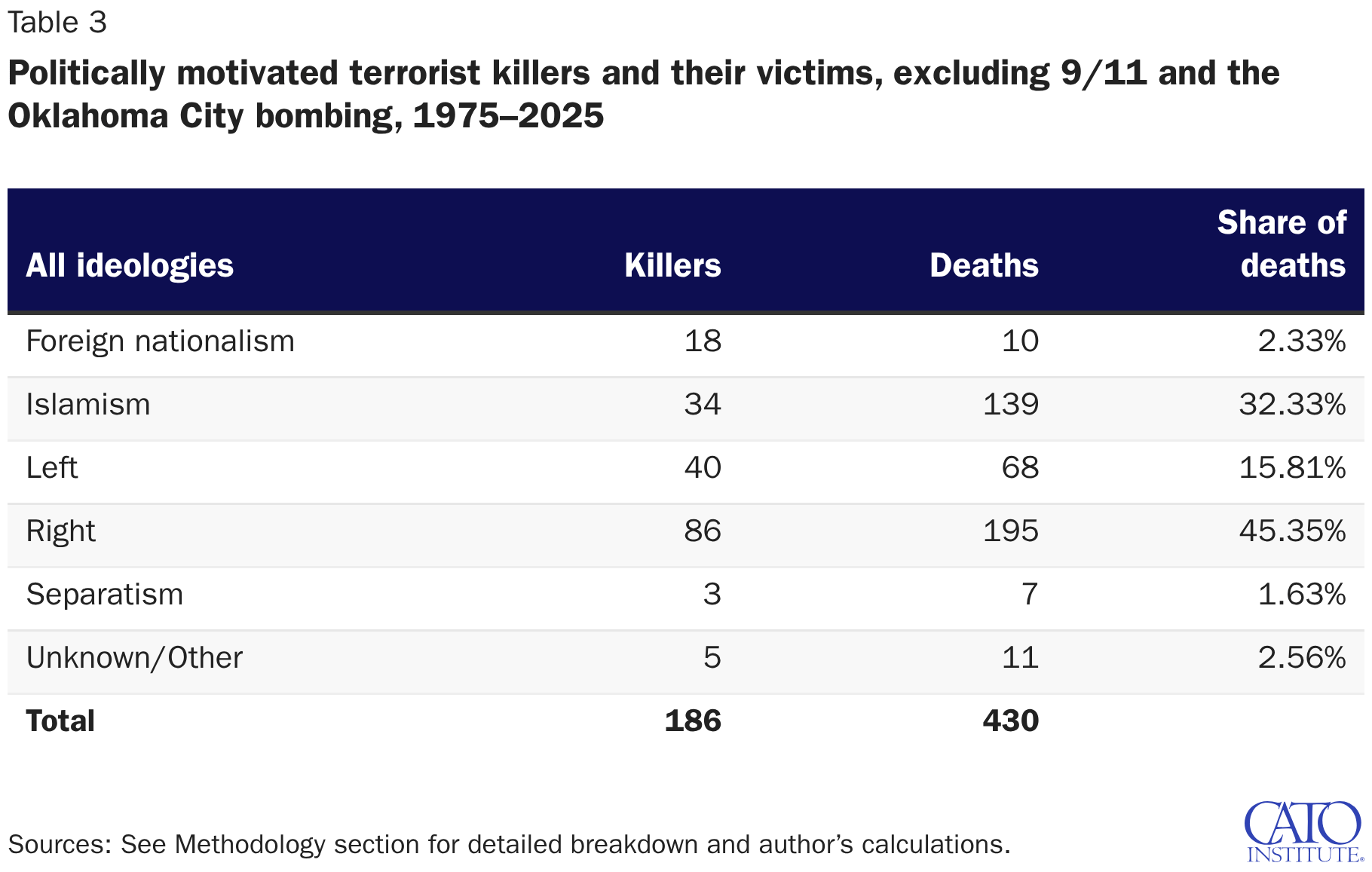
Over that period, right-wing extremists were responsible for significantly more killings than left-wing extremists. Even when excluding major outliers like the September 11 attacks and the Oklahoma City bombing—the latter classified as right-wing extremist terrorism in standard research frameworks—the imbalance remains. More recent data since 2020 shows a similar pattern, with right-wing incidents accounting for a larger share of politically motivated killings than left-wing incidents.
None of this makes political violence acceptable, regardless of source. But it does challenge the idea that it belongs almost entirely to one side of the political spectrum. What’s more interesting, though, isn’t just the data. It’s how resistant people can be to it.
In the same thread, the conversation quickly shifted away from numbers and toward redefinitions, edge cases, and attempts to reclassify events that don’t fit the narrative. This is a familiar pattern: when the facts don’t align with a belief, the categories themselves start to move.
It’s not really about data at that point. It’s about identity, and about maintaining a sense of certainty in a noisy environment.
There’s also a structural problem. Most people aren’t reading 50-year datasets or policy analyses. They’re reacting to fragments: clips, headlines, and anecdotes that confirm what they already suspect. Over time, those fragments harden into something that feels like common sense. But common sense isn’t always the same as reality.
If there’s any takeaway here, it’s not that one side is “worse” in some absolute sense. It’s that broad, absolute claims, especially ones that assign blame entirely to one group, tend not to survive contact with actual data.
And maybe more importantly, that it’s still possible to pause, look at the evidence, and adjust your view, even if it’s uncomfortable.
That’s not something the algorithm rewards, but it might still be worth doing.
— Sweeney the Genie
→ Return to the Porch
→ About the Porch Genie
→ Uncork the Bottle